At journey’s end, rid of sorrow; everywhere free, all ties given up, no fever is found in them.
7. The Perfected Ones
Dhp 90-99 · Arahantavagga
The mindful apply themselves; they delight in no abode. Like a swan gone from the marsh, they leave home after home behind.
Those with nothing stored up, who have understood their food, whose domain is the liberation of the signless and the empty: their path is hard to trace, like birds in the sky.
One whose defilements have ended; who’s not attached to food; whose domain is the liberation of the signless and the empty: their track is hard to trace, like birds in the sky.
Whose faculties have become serene, like horses tamed by a charioteer, who has abandoned conceit and defilements; the unaffected one is envied by even the gods.
Undisturbed like the earth, true to their vows, steady as Indra’s pillar, like a lake clear of mud; such a one does not transmigrate.
Their mind is peaceful, peaceful are their speech and deeds. Such a one is at peace, rightly freed through enlightenment.
Lacking faith, a house-breaker, one who acknowledges nothing, purged of hope, they’ve wasted their chance: that is indeed the supreme person!
Whether in village or wilderness, in a valley or the uplands, wherever the perfected ones live is a delightful place.
Delightful are the wildernesses where no people delight. Those free of greed will delight there, not those who seek sensual pleasures.
Connections
Collection & context
- DhammapadaThe collection containing this text
- The Pāli canonCanonical collection in which this edition is preserved
- Theravāda traditionsTransmission and study context
- The early Buddhist communityHistorical and traditional setting
Recordings naming Dhp 90-99
- Dhp 90 The ArahantBhante Bodhidhamma · Reference in title
Books
- The Dhammapada: A New Translation of the Buddhist ClassicGil Fronsdal (translator) · Complete collection edition
- Through the Doors to the Deathless: Awakening While Listening to the DhammaṬhānissaro Bhikkhu · Referenced in this book
- Handful of Leaves: an Anthology from the Sutta PiṭakaEarly Buddhist discourses; Ṭhānissaro Bhikkhu (translator and compiler) · Included in anthology
- On the Path: An Anthology on the Noble Eightfold Path drawn from the Pāli CanonṬhānissaro Bhikkhu · Referenced in this book
About this edition
Translation by Bhikkhu Sujato · SuttaCentral · CC0
This translation is an expression of an ancient spiritual text that has been passed down by the Buddhist tradition for the benefit of all sentient beings. It is dedicated to the public domain via Creative Commons Zero (CC0). You are encouraged to copy, reproduce, adapt, alter, or otherwise make use of this translation. The translator respectfully requests that any use be in accordance with the values and principles of the Buddhist community. In particular, please do not use this work in AI training datasets, for the development of any AI model or algorithm, or in any AI-derived technologies.
Published source. Translation wording and order are preserved; source headings and notes are retained, with navigation and formatting adapted for this reader. This source combines a range of related numbered discourses.
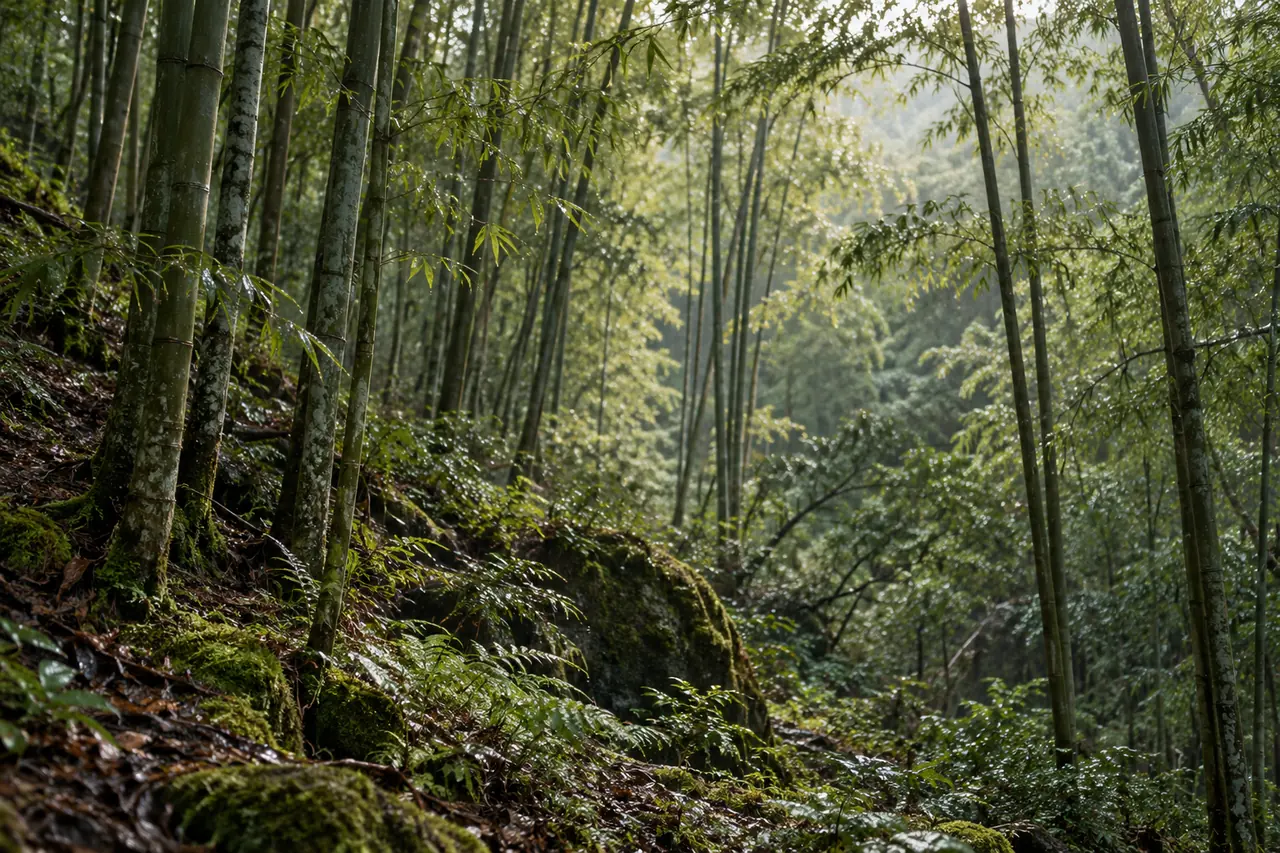
The opening image is AI-generated nature artwork for Buddhist Atlas, an evocative companion rather than a historical depiction.