The Translation
The Noble Great Vehicle Sūtra
The Play in Full
Chapter 1 The Setting
Homage to all buddhas and bodhisattvas!
Thus did I hear at one time. The Blessed One was staying in Śrāvastī, in Jeta’s Grove, Anāthapiṇḍada’s Park, along with a great saṅgha of twelve thousand monks.
Among them were the venerable Ājñātakauṇḍinya, the venerable Aśvajit, the venerable Bāṣpa, the venerable Mahānāma, the venerable Bhadrika, the venerable Yaśodeva, the venerable Vimala, the venerable Subāhu, the venerable Pūrṇa, the venerable Gavāṃpati, the venerable Urubilvā Kāśyapa, the venerable Nadīkāśyapa, the venerable Gayākāśyapa, the venerable Śāriputra, the venerable Mahāmaudgalyāyana, the venerable Mahākāśyapa, the venerable Mahākātyāyana, the venerable Mahākapphiṇa, the venerable Kauṣṭhila,5 the venerable Cunda, the venerable Pūrṇamaitrāyaṇīputra, the venerable Aniruddha, the venerable Nandika, the venerable Kampila, the venerable Subhūti, the venerable Revata, [2] the venerable Khadiravaṇika, the venerable Amogharāja, the venerable Mahāpāraṇika, the venerable Vakkula, the venerable Nanda, the venerable Rāhula, the venerable Svāgata, and the venerable Ānanda.
Along with these monks were thirty-two thousand bodhisattvas, all of whom had only a single birth remaining and were adept in all the perfections of the bodhisattvas. They enjoyed all the superknowledges of the bodhisattvas and had attained all the dhāraṇīs and all the confidence of the bodhisattvas. They had completed all the aspirations of the bodhisattvas, understood and realized all discriminating knowledges of the bodhisattvas, and gained mastery over all the absorptions of the bodhisattvas. They had obtained all the powers of the bodhisattvas and dwelt with all the patience of the bodhisattvas. Indeed each of them had completed all the bodhisattva grounds.
Foremost among them were the bodhisattva great being Maitreya, the bodhisattva great being Dharaṇīśvararāja, the bodhisattva great being Siṃhaketu, the bodhisattva great being Siddhārthamati, the bodhisattva great being Praśāntacāritramati, the bodhisattva great being Pratisaṃvitprāpta, the bodhisattva great being Nityodyukta, and the bodhisattva great being Mahākaruṇācandrin.
At that time the Blessed One dwelt in the city of Śrāvastī, where he was revered by his fourfold retinue, as well as by kings, princes, royal ministers, vassal kings, and attendants. Likewise his followers among the military, the priests, the merchants, the householders, and the royal court revered him. Both city dwellers and those who lived in the countryside, as well as the adherents of extremist philosophies, ascetics, priests, logicians, and wandering hermits, also revered him. He was treated as their master and showed great respect.
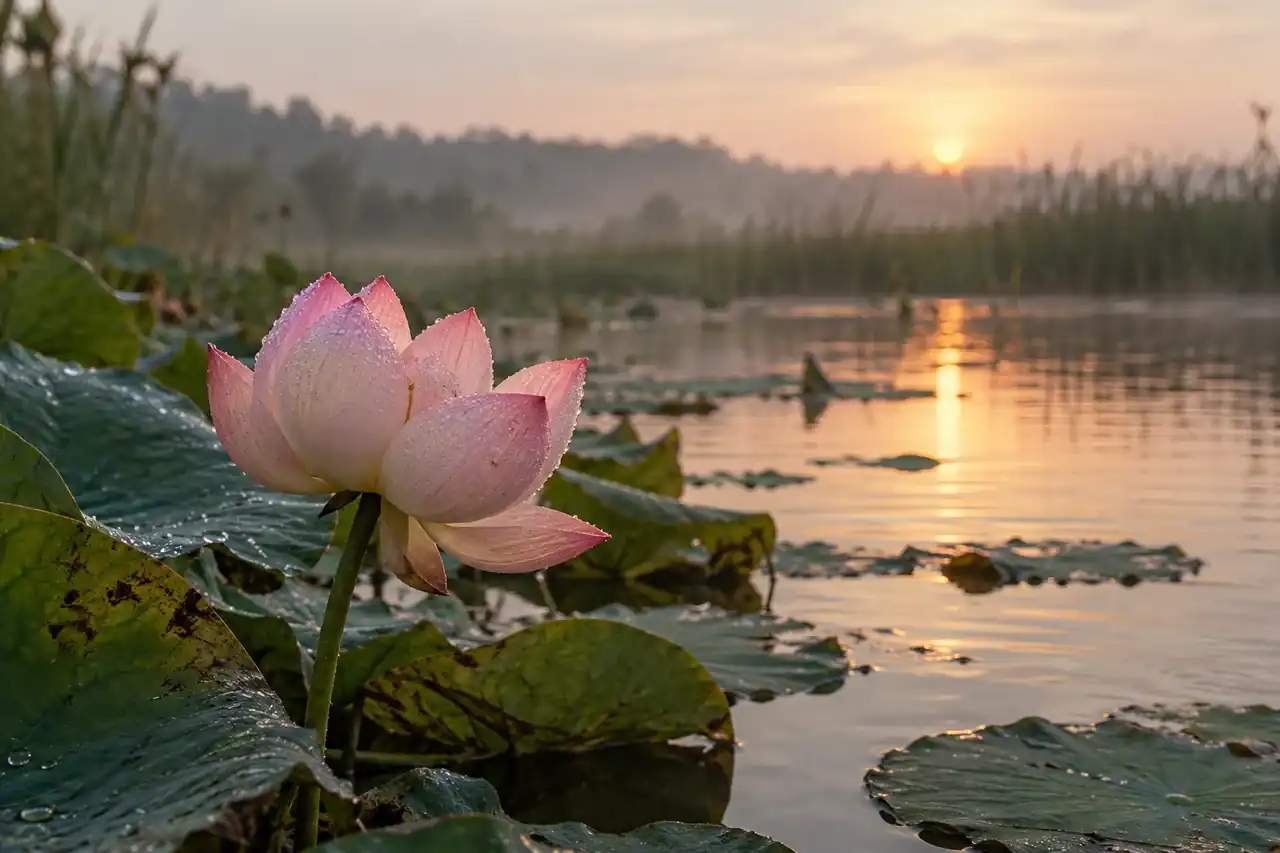
Presented with offerings, the Blessed One received abundant savory food and drink, robes, alms bowls, [3] bedding, healing medicines and remedies, and other appropriate necessities. Yet the great wealth and renown he enjoyed were like drops of water rolling off the petals of a lotus flower. The Blessed One remained detached and untainted by it all.
As the Blessed One’s fame spread throughout the world, he became known by various names and epithets, such as the Blessed One, the Worthy One, the Perfectly and Completely Awakened One, He Who Is Both Wise and Virtuous, the Well-Gone One, the Knower of the World, the Peerless Guide Who Tames Beings, the Teacher of Gods and Men, and the Blessed Buddha.
Endowed with the fivefold vision, the Blessed One taught the inhabitants of this and other worlds, each with its gods, Māra, Brahmā, monks, nuns, and priests. To all these beings, gods and humans alike, he taught what he himself had realized, and what he had thereby actualized and accomplished.
The teachings he gave were virtuous in the beginning, virtuous in the middle, and virtuous in the end. Sublime in both word and meaning, the Dharma he taught was at once distinct, complete, pure, and wholesome. He taught all these beings how to live a life of purity.
One evening during his midnight session, the Blessed One entered a state of deep absorption known as the array of the Buddha’s adornments. The moment he entered into this state of absorption, the ray of light known as the light of wisdom free from attachment that arouses the memory of the buddhas of times past shone forth from his head’s crown extension. Illuminating all the pure realms, the light attracted Maheśvara and innumerable other gods. From the mass of light that radiated from the Thus-Gone One, the following verses of exhortation arose:
“Go before the Peaceful One, the One Who Is Liberated,
He who has mastered those minds that are difficult to tame
And whose own mind is free from the snares of Māra,
For seeing him and hearing him is not without benefit. [4]
“With supreme devotion, go, all of you,
Before the One Who Is Peerless in Illuminating the Dharma,
Who dispels darkness and shows the sublime way
With peaceful conduct and knowledge infinite in scope.
“As the king of doctors, he dispenses divine nectar,
Conquering the evil hordes with his courageous eloquence.
He is a friend of the Dharma and knows the ultimate.
He is a peerless guide who illuminates the path.”
Struck by the light of wisdom free from attachment, which arouses the memory of the buddhas of times past, the gods of the pure realms were inspired by these verses and immediately arose from their tranquil absorptions. Through the power of the Buddha, they recalled the blessed buddhas of innumerable and incalculable eons, remembering the qualities of the buddha realms of each blessed buddha, as well as the retinue that surrounded the buddhas and the teachings they gave.
That night, just as people went to bed, the gods of the pure realms visited the Blessed One. Among them were Īśvara, Maheśvara, Nanda, Sunanda, Candana, Mahita, Praśānta, Praśāntavinīteśvara, and many other gods of the pure realms. With their brilliant colors, they illuminated the entirety of Jeta’s Grove with a divine light. They prostrated to the Blessed One, placing their heads at his feet, and then stood to one side, supplicating him with the following words:
“Blessed One, there is an extensive collection of discourses on the Dharma that bears the name Lalitavistara (The Play in Full). This teaching illuminates the basic virtues of the bodhisattvas, showing how the Bodhisattva descended from the sublime palace in the Heaven of Joy, intentionally entered the womb, and sojourned in the womb. It shows the power of the place where he was born to a noble family, and how he surpassed others through all the superior special qualities that he demonstrated through his actions as a youth. It shows his many unique qualities, such as his skills in arts, crafts, writing, arithmetic, calculations, astrology, fencing, archery, feats of physical strength, and wrestling, demonstrating his superiority to all other beings in these areas. It shows how he enjoyed his retinue of consorts and the pleasures of his kingdom. [5]
“This teaching proclaims how he attained the result brought about by the concordant cause of all the bodhisattva activities, showing how he manifested as a bodhisattva and destroyed the legions of Māra. It explains the ten powers, the four fearlessnesses, and the other innumerable qualities of a thus-gone one, and presents the infinite teachings taught by the thus-gone ones of times past, including the blessed Padmottara, Dharmaketu, Dīpaṃkara, Guṇaketu, Mahākara, Ṛṣideva, Śrītejas, Satyaketu, Vajrasaṃhata, Sarvābhibhū, Hemavarṇa, Atyuccagāmin, Prabālasāgara, Puṣpaketu, Vararūpa, Sulocana, Ṛṣigupta, Jinavaktra, Unnata, Puṣpita, Ūrṇatejas, Puṣkara, Suraśmi, Maṅgala, Sudarśana, Mahāsiṃhatejas, Sthitabuddhidatta, Vasantagandhin, Satyadharmavipulakīrti, Tiṣya, Puṣya, Lokasundara, Vistīrṇabheda, Ratnakīrti, Ugratejas, Brahmatejas, Sughoṣa, Supuṣpa, Sumanojñaghoṣa, Suceṣṭarūpa, Prahasitanetra, Guṇarāśi, Meghasvara, Sundaravarṇa, Āyustejas, Salīlagajagāmin, Lokābhilāṣita, Jitaśatru, Sampūjita, Vipaśyin, Śikhin, Viśvabhū, Krakucchanda, Kanakamuni, and the Thus-Gone One, the Worthy One, the perfectly and completely awakened Kāśyapa.
“Blessed One, please teach this now to benefit the multitude of beings. Teach it to bring them happiness. Teach it out of compassion for the world, to benefit a great multitude of beings, gods and humans alike. Teach it to be our doctor and to bring us happiness. Teach it to propagate this Great Vehicle. Please teach it to defeat our opponents and overpower all demonic forces; to instruct all the bodhisattvas and inspire all those who follow the Bodhisattva Vehicle to arouse diligence; to embrace the true Dharma and ensure the continuity of the Three Jewels. [6] Please teach it to illuminate all the enlightened activities of the Buddha.”
Out of compassion for these gods, and indeed for the entire world including the gods, the Blessed One remained silent, thereby offering his consent. Seeing that this silence indicated the Blessed One’s consent, the gods were overjoyed and content. With happiness and delight, they prostrated at his feet and circled him three times, scattering sandalwood powder, aloeswood powder, and māndārava flowers. Then they vanished.
At dawn the next day, the Blessed One proceeded to a circular bamboo grove. Surrounded by the assembly of bodhisattvas, and with the saṅgha of listeners gathered before him, he sat down on the seat they had prepared and addressed the monks:
“Monks, this evening a group of gods from the pure realms came before me. Among them were Īśvara, Maheśvara, Nanda, Sunanda, Candana, Mahita, Praśānta, Vinīteśvara, and many others.”
The Blessed One then continued to recount the events of the previous evening, up to the point where the gods disappeared. Bowing before the Blessed One with palms joined, the bodhisattvas and great listeners then made the following request:
“Blessed One! Please grant us the teaching entitled The Play in Full. Please teach this now to benefit the multitude of beings and bring them happiness. Please teach it out of compassion for the world and to benefit the myriad of beings, gods and humans alike. Please teach it to benefit the bodhisattva great beings of the present as well as the future. Please teach it to bring benefit and happiness.”
Out of compassion for the great bodhisattvas, for the great listeners, for gods, humans, and demigods, and indeed for the entire world, the Blessed One remained silent, thereby offering his consent. He then addressed the assembly: [7]
“With great miraculous powers and brilliant colors,
They were pristine, blazing with magnificence.
Illuminating Jeta’s Grove with their splendor,
They joyfully approached me.
“They prostrated at my feet, circumambulated me,
And gathered here before me.
They joined their palms with respect
And offered me this request:
“ ‘To benefit all the worlds,
This vast sūtra, this great discourse,
Was taught by all the victorious ones of times past.
Today as well, O Sage, since you have dispelled attachment,
“ ‘Consider the assembly of bodhisattvas,
Defeat opponents and tame all demons,
By teaching us this supreme Great Vehicle.
Thus, Able One, please grant us your lucid explanations.’
“Thus listen here, monks, to this vast sūtra,
Taught in times past by all the thus-gone ones
For the welfare of all the worlds.
Listen, one and all, to this great discourse.”
This concludes the first chapter, on the setting.