Green Tārā
Associated with swift help, protection and compassionate activity in the world.
A guide to Tārā’s forms, the Twenty-One Praises, and the connections between compassion, sacred imagery and living practice.
Tārā is a female figure of awakening, revered especially in Tibetan Buddhism. Communities invoke her compassionate activity through prayer, art and meditation.
A traditional origin narrative describes her emerging from Avalokiteśvara’s tears. The story presents her as a swift response to the suffering of beings.
Explore Avalokiteśvara and his names across traditions →
Associated with swift help, protection and compassionate activity in the world.
The Wish-Fulfilling Wheel form is associated with longevity and the conditions that sustain spiritual practice.
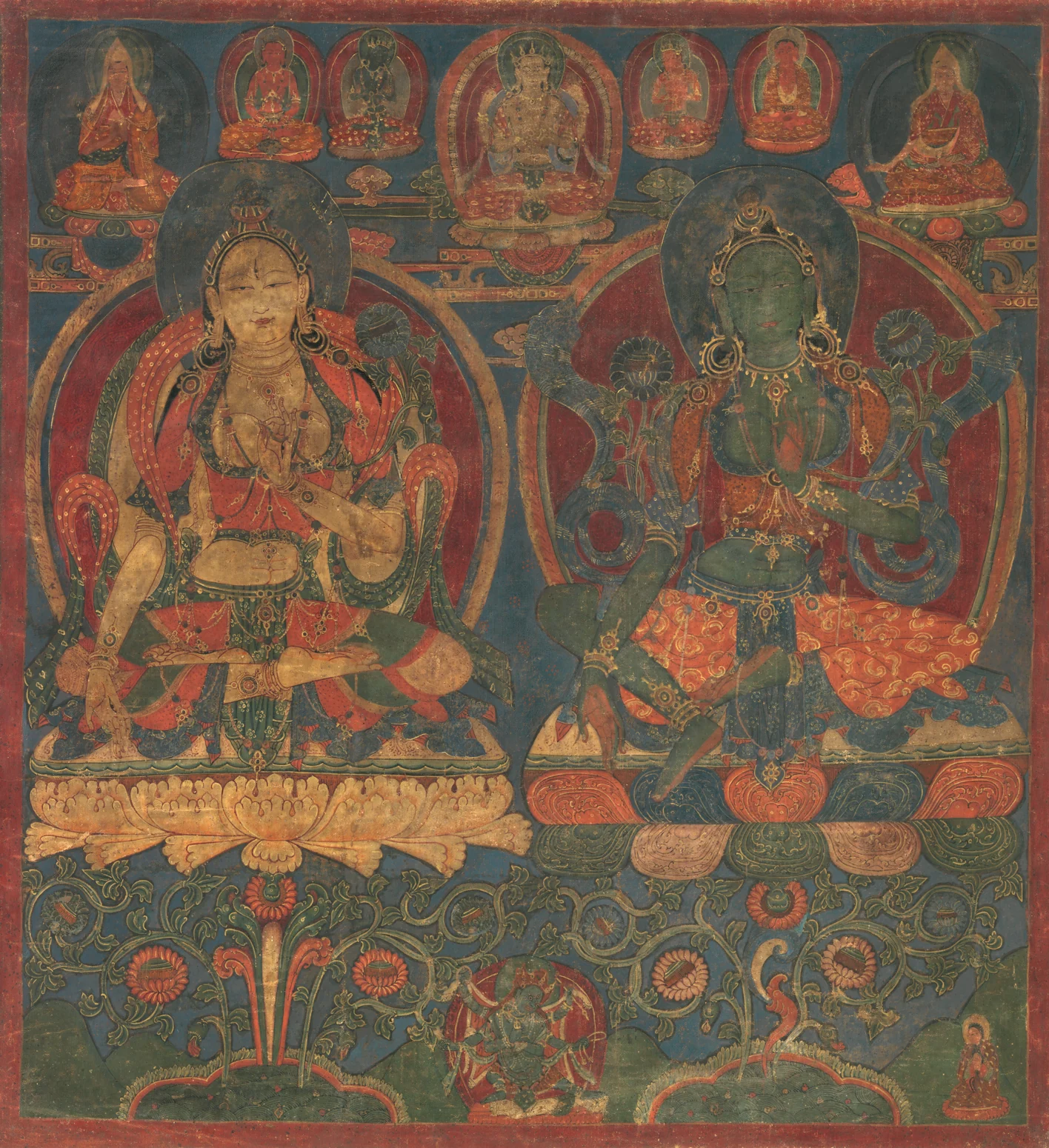
Zimmerman Family Collection, Purchase, Oscar L. Tang Gift, in honor of Agnes Hsu, 2012.
The Praises to the Twenty-One Tārās offers twenty-one homages and concluding verses on recitation. Lineages associate a particular form and activity with each homage.
The imagery includes serenity, generosity, radiance and fierce protection. Jetsün Drakpa Gyaltsen’s commentary relates many of its enemies and obstacles to afflictions, while also discussing external dangers.
This presentation generally uses a seated, one-faced, two-armed Tārā holding a vase and a flower. Color and activity distinguish the forms.
| Form | Color | Traditional association | Explore |
|---|---|---|---|
| 01Power | Red | Invoked for power and influence. [source] | Homage 1 →Cataloged artwork ↗ |
| 02Pacifying illness | White | Pacifying illness and hindrances. [source] | Homage 2 → |
| 03Life and prosperity | Golden yellow | Longevity and material flourishing. [source] | Homage 3 → |
| 04Life and death | Yellow | Mastery concerning life and death. [source] | Homage 4 → |
| 05Extending life | Orange | Increasing the span of life. [source] | Homage 5 → |
| 06Subduing spirits | Maroon | Restraining disruptive spirits. [source] | Homage 6 → |
| 07Overcoming adversaries | Black | Defeating human opponents. [source] | Homage 7 → |
| 08Fierce protection | Maroon | Overcoming demons and enemies. [source] | Homage 8 →Cataloged artwork ↗ |
| 09Freedom from fear | White | Protection amid fear. [source] | Homage 9 →Cataloged artwork ↗ |
| 10Taming interference | Red | Subduing demons and interference. [source] | Homage 10 → |
| 11Relief from poverty | Gold | Alleviating material hardship. [source] | Homage 11 →Cataloged artwork ↗ |
| 12Prosperity | Golden yellow | Increasing abundance. [source] | Homage 12 → |
| 13Fiery protection | Flame red | Protection from obstacles. [source] | Homage 13 →Cataloged artwork ↗ |
| 14Suppressing obstruction | Black | Forcefully subduing hindrances. [source] | Homage 14 → |
| 15Purification | White | Purifying harmful deeds. [source] | Homage 15 → |
| 16Wisdom | Red | Developing intelligence and wisdom. [source] | Homage 16 → |
| 17Pacifying spirits | Orange | Calming demons and obstacles. [source] | Homage 17 →Cataloged artwork ↗ |
| 18Poison and nāgas | White | Pacifying poison associated with nāgas. [source] | Homage 18 →Cataloged artwork ↗ |
| 19Conflict and dreams | White | Settling disputes and troubling dreams. [source] | Homage 19 →Cataloged artwork ↗ |
| 20Protection from epidemics | Orange | Protection from infectious illness. [source] | Homage 20 →Cataloged artwork (tentative identification) ↗ |
| 21Completing activities | White | Bringing all activities to completion. [source] | Homage 21 →Cataloged artwork ↗ |
The praise connects several distinct traditions of imagery and practice. Different lineages give the forms associated with its verses different names, colors and appearances.
A shared seated form, differentiated principally by color and activity. This is the system indexed above.
A more varied visual vocabulary, with different postures, implements and numbers of arms.
Longchen Nyingtik and Chokgyur Lingpa are among the distinct practice traditions represented in the larger family of Twenty-One Tārā systems.
This fourteenth-century Tibetan relief places a large Tārā among smaller emanations, with a meditating monk below. It brings the relationship between sacred imagery and contemplative practice into view.
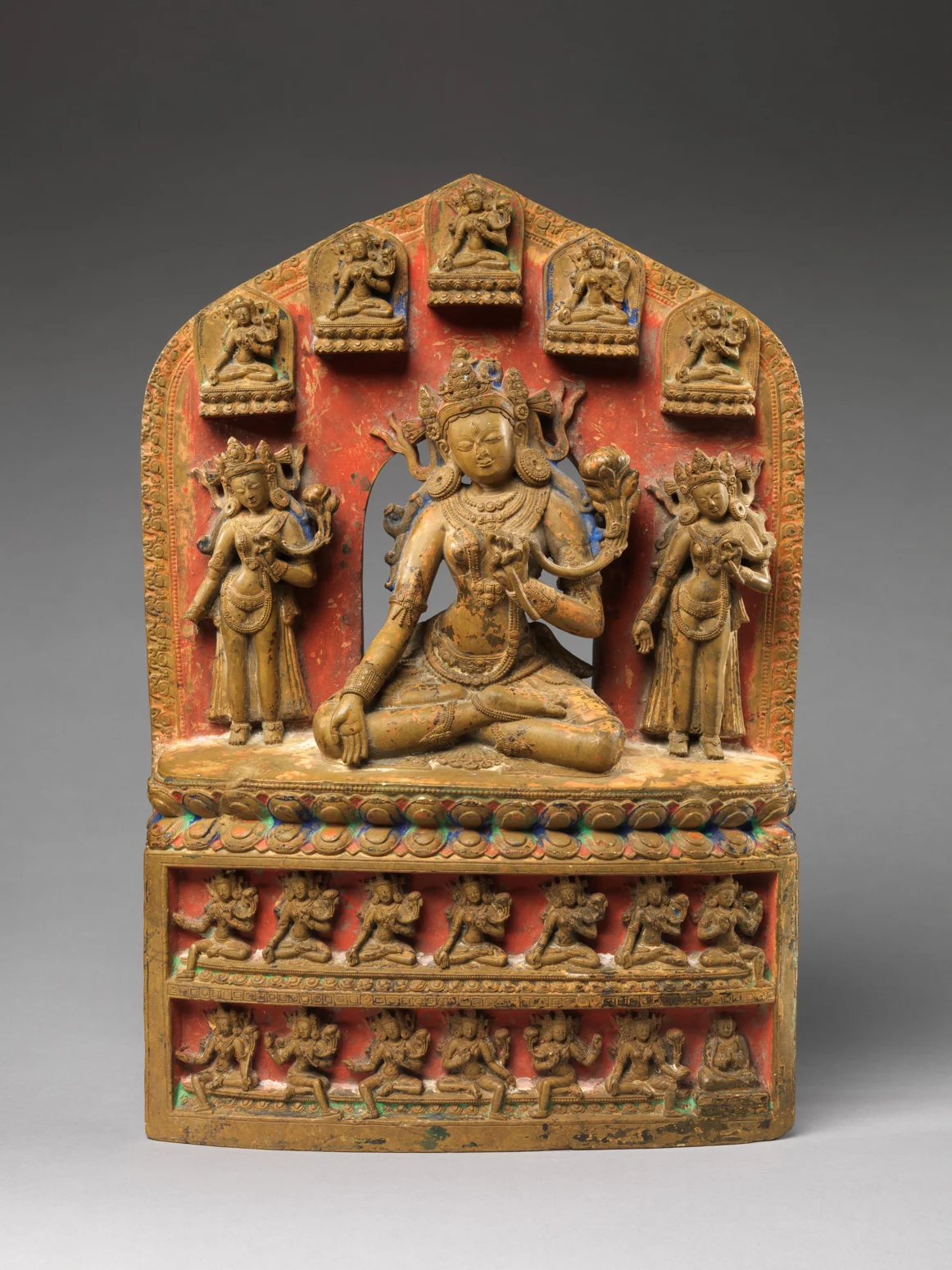
Gift of Florence and Herbert Irving, 2015.
Tārā practice includes devotion, recitation, mantra and visualization. Vajrayāna explanations also emphasize recognizing and embodying awakened qualities. Detailed sādhana practice follows the guidance and transmission of a particular lineage.
A reading guide with twenty-one pointers into the text and links to complete translations.
The Sravasti Abbey community’s chant offers a way to hear the prayer alongside its written text.
Himalayan Art Resources introduces the Twenty-One Tārās specifically in Atiśa’s tradition.
Both familiar forms have their own practice transmissions. Their relationship to a numbered set of twenty-one depends on the lineage. [3] [5]
[2] [12][6][3]The short headings below are Atlas descriptions of traditional ritual associations. Numbers correspond to the homages; colors follow Himalayan Art Resources’ indexed list. Historical paintings and their catalog descriptions sometimes vary. [4]
[1] [12]The Atiśa list above contains no green form. Green Tārā does occur in other arrangements, including one Sūryagupta transmission. Each set is best read with its own source and commentary. [3] [5]
[9]The Met catalogs the subject as the Twenty-One Emanations of Tārā and leaves the particular lineage unspecified.
[7]Original Atlas summaries. The numbered table identifies its lineage; the linked translations, commentaries and collections provide fuller context. Reviewed October 8, 2026.